

While military veterans are common in the nuclear industry, Harris Nuclear Plant’s Carmen Lewis and Gray Tompson have an uncommon story.
Lewis, an instructor in Operations Training and Tompson, a senior human performance coordinator in Maintenance, both served as officers in the U.S. Navy, but their connection goes back prior to commissioning. Lewis and Tompson were squad mates while cadets at the U.S. Naval Academy in Annapolis, Md.
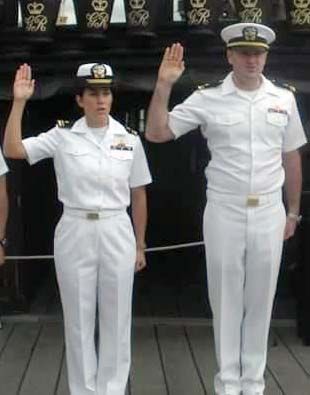 Carmen Lewis (left) and Gray Tompson were once squad mates at the U.S. Naval Academy. Now, they help provide electricity to nearly 1,000,000 people in North Carolina.
“Since then, our careers have taken the same track,” Lewis said, “and ultimately, we ended up here (at Harris Nuclear Plant).”
After the Naval Academy, they both completed the Navy’s Nuclear Power School in Charleston, S.C. and later ended up on the U.S.S. George H.W. Bush where Lewis was a reactor operator and Tompson oversaw maintenance operations on many of the ship’s nuclear and non-nuclear systems. Lewis left the Navy in 2012 and joined Duke Energy at the Harris Nuclear Plant in 2013. Tompson spent a year at Ft. Bragg with the Special Operations Joint Command before leaving active duty in 2013. He still serves in the Navy Reserves as a lieutenant assigned to the Military Sealift Command. He joined Duke Energy in 2014.
Tompson credits his active duty service with helping ease the transition to commercial nuclear power.
“While I was active, I qualified as an operator for a Westinghouse pressurized water reactor, and much of the theory and even terminology is identical,” Tompson said. “I started here day one with a good understanding of how the plant works which translated into an appreciation for how various problems impact nuclear safety.
In a more general sense, my time in the military taught me the value of ‘pulling your weight.’ No one else can do your task but you. Success relies on every task being complete at the right time.”
Duke Energy has a long history of employing veterans of the United States Armed Forces across its enterprise. It is Duke’s longstanding belief that the knowledge and skills gained in the military translate well to a rewarding career in the electric utility industry. Veterans know how to evaluate risk, work as part of a team, overcome obstacles and solve problems. Duke Energy values these qualities in its workforce.
Duke Energy’s nuclear fleet – and the nuclear industry as a whole – is especially interested in graduates of the U.S. Navy’s Nuclear Propulsion program, like Tompson and Lewis, since the fundamentals and components education graduates receive is directly applicable to careers at nuclear power plants. With the shortage of skilled workers in nuclear energy, and the impending retirement of a significant number of workers, this pipeline is of vital importance to the industry.
“U.S. military veterans are, and will continue to be, vital to our nuclear workforce,” said Duke Energy’s Chief Nuclear Officer Bill Pitesa. “Across our fleet, former sailors, airmen, soldiers, marines and guardsmen and women are integral to the safe and efficient operation of our nuclear facilities.”